
Features at a glance
Discover how to integrate the AI-powered chat into your daily work – for research, documents, emails, and more.Enterprise Search
Search across all relevant data sources in one place: the web for up-to-date information, your internal knowledge for answers from documents, and connected apps like OneDrive, SharePoint, or Outlook.
Tasks
Create slides, documents, notes, and emails, and complete your key tasks in one place. You can also research on the web, generate images and videos, analyze data, build workflows, and create your own agents.
Type @ to reach all your AI
Simply type
@ while writing to open a menu with your AI apps, agents, skills, prompts, voices, and workflows, and use them directly in chat.Workflows
Automate recurring tasks by combining multiple steps into a workflow. You control the logic in the chat while your workflow is built in parallel in the editor.
Orchestrator
Handle complex tasks with the Orchestrator. It has multiple skills and can orchestrate agents and tools. It finds relevant data and executes tasks step by step – across documents, slides, visuals, and workflows.
LLM-agnostic Chat
Interact with the latest and most powerful LLMs in one interface. In nuwacom, you can choose models like GPT-5.5, Claude Opus 4.8, or Gemini 3.1 Pro Preview – for text, data analysis, and multimodal tasks.
Attach files and images
Add relevant files, templates, images, or knowledge to give the AI more context. This allows it to generate content directly based on your data – in the right format, layout, and brand style.
Collaboration
Easily share chats with your team and build on existing results together – across your entire workspace or with specific individuals.
Input field
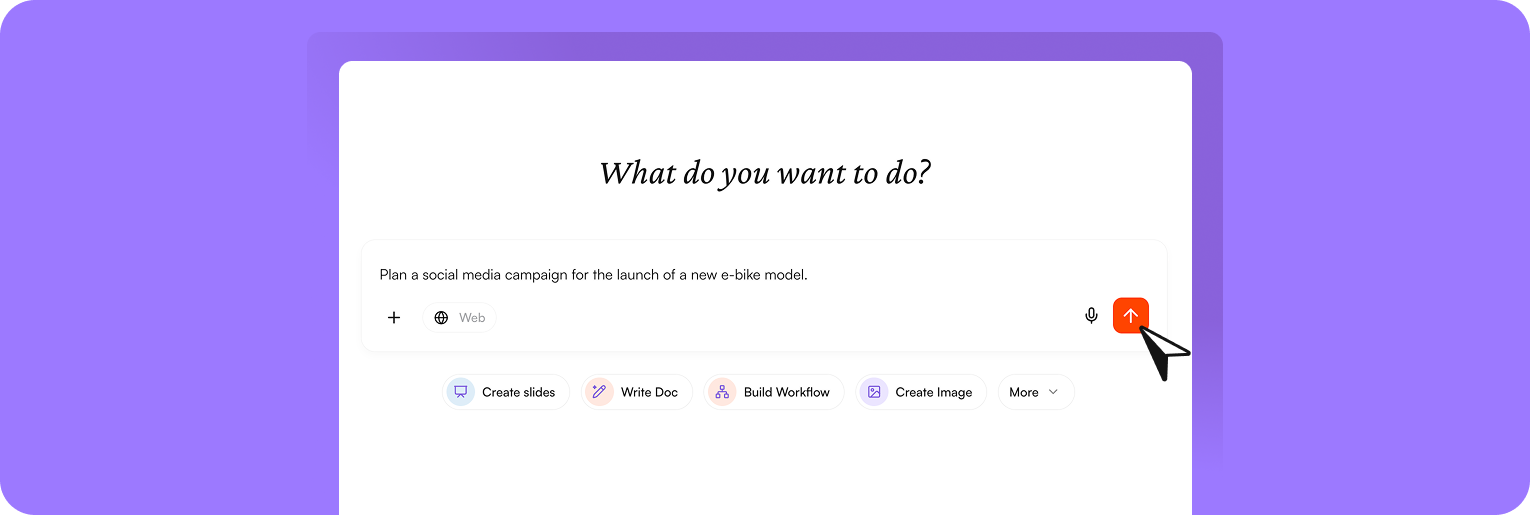
- Ask questions: Get answers based on your internal knowledge base, the web, or connected apps. To activate a source, click the + icon in the input field and enable the desired source (internal knowledge, web, or apps).
Example: “What are the key arguments for our product compared to competitors?” - Access up-to-date information: Retrieve current information from the internet by asking a question. Web search is enabled by default and used automatically.
Example: “What are the three key trends in B2B content marketing in the software industry right now?” - Real results: Start your work directly in the chat and create slides, documents, notes, emails, and more in one place. The AI provides results as downloadable files such as presentations (.pptx), Excel sheets (.xlsx), or text files (.txt).
- Automate tasks: Use the orchestrator or workflows to efficiently handle recurring or complex tasks.
Example: “Create a landing page structure for our new campaign including H1, CTA, and bullet points.”
Actions in chat
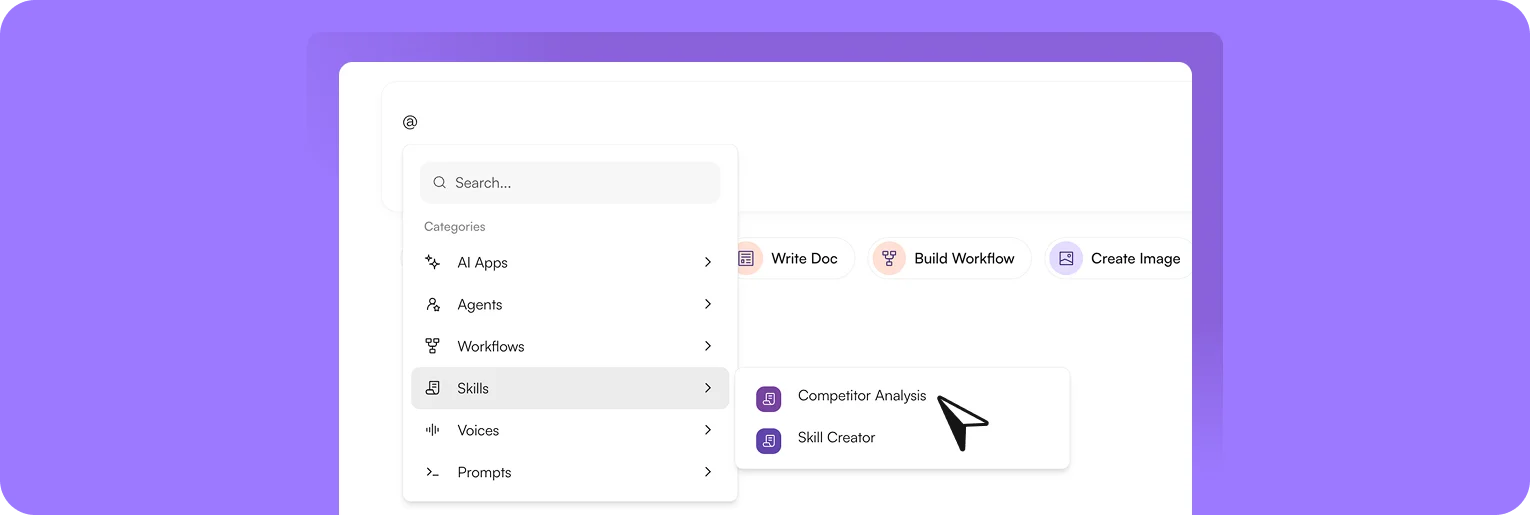
Call an action with the @ symbol
- Open a chat.
- Type @ in the input field.
- Select the action you want to use.
- Agents: Start specialized assistants for specific tasks.
- Skills: Use predefined capabilities, for example to create documents, slides, or other results.
- Prompts: Use saved prompts from your prompt library.
Add files and sources with the + button
The + button complements actions in chat. You can use it to attach files or images and select sources for your request. With the + button, you can, for example:- Upload files
- Attach images
- Select content from the knowledge base
- Search connected sources and integrations
Use multiple actions
You can type @ again at any time to add more actions. This is helpful if you realize while working that you also need a specific agent, skill, or prompt. Example: You first start an agent for research and then use a saved prompt to turn the results into a LinkedIn post.Tasks
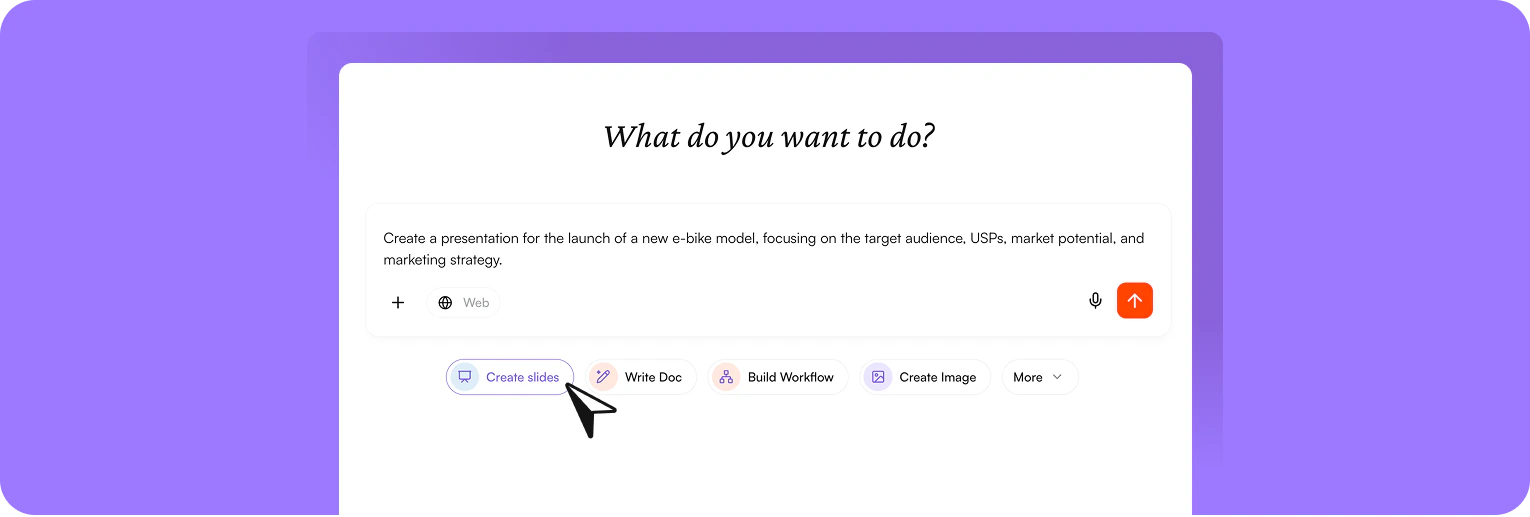
- Use Orchestrator – Start complex tasks that are automatically planned, coordinated, and handled by specialized agents.
- Create slides – Generate presentation slides for meetings or pitches.
- Create document – Write structured content such as concepts or reports.
- Build workflows – Automate recurring processes by connecting multiple steps.
- Write notes – Capture ideas or meeting notes.
- Research – Conduct structured research on markets, competitors, or trends.
- Search company knowledge – Explore company knowledge and find relevant information from connected sources.
- Generate images – Create visual content from a description.
- Generate videos – Create videos based on text descriptions.
- Analyze data – Evaluate or summarize datasets.
- Create agent – Build your own AI agents to support recurring tasks.
- Draft email – Write professional emails.
Model selection

- Auto Mode: Delivers the right balance of speed, quality, and resource efficiency. Simple requests are handled quickly, while more complex tasks are routed to a more powerful model.
- Manual Model Selection: Alternatively, you can choose a specific model from the model dropdown. This selection overrides Auto Mode for the current request.
- Latest AI Models from Leading Providers: Choose from powerful models such as GPT-5.5, Claude Opus 4.8, or Gemini 3.1 Pro Preview, ideal for text generation, data analysis, and multimodal tasks.
- Flexible Hosting Options: Choose between EU-hosted models (GDPR-compliant and privacy-focused) and US-hosted models.
- Available Even During Provider Outages: If an LLM provider becomes temporarily unavailable, your chat continues through an automatic multi-provider fallback chain. All fallback models remain EU-hosted.
- The Right Model for Every Task: Whether you need fast responses for routine work, advanced reasoning for complex topics, or support for visual content, there is a suitable model for every scenario.
Attach files and images
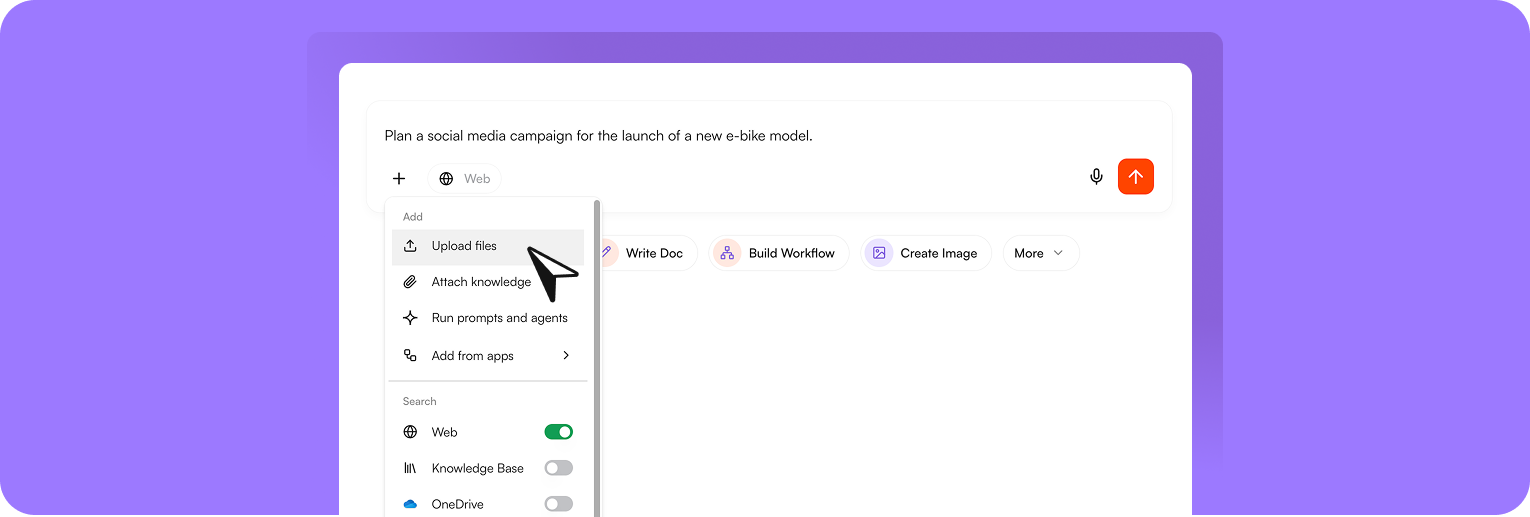
- Drag and drop files into the chat (PDF, Word, Excel)
Example: Drag your product brochure into the chat – the AI can use it to create a clean press release. - Upload presentations, guides, or FAQs
Example: Upload your latest campaign analysis PPT so the AI can create a management report. - Use your own templates for slides and documents
Example: Upload your presentation or document template so the AI creates new content in the correct layout and brand style. - Upload images for content or visual analysis
Example: Add a diagram – the AI can describe, summarize, or integrate it into supporting text. - Attach files
Example: Use your style guide from the knowledge base so the AI writes in your exact brand voice. - Add content from nuwacom
Example: Use content you created in nuwacom, such as documents, emails, slides, or meeting notes. - Connect data from OneDrive and Google Drive
Access content from your cloud storage – such as presentations, briefings, or reports – and automatically provide the AI with the necessary information.
Supported file formats
Supported file formats
Plain text & markup
application/jsontext/plaintext/markdowntext/htmlapplication/xmltext/xmltext/x-rstapplication/rtftext/rtf
application/vnd.ms-outlookmessage/rfc822
image/jpegimage/pngimage/webpimage/gif(non-animated)
application/mswordapplication/vnd.openxmlformats-officedocument.wordprocessingml.documentapplication/vnd.oasis.opendocument.textapplication/epub+zip
text/csvapplication/vnd.ms-excelapplication/vnd.openxmlformats-officedocument.spreadsheetml.sheet
application/vnd.ms-powerpointapplication/vnd.openxmlformats-officedocument.presentationml.presentation
application/pdf
audio/mpegaudio/wavaudio/oggaudio/flacaudio/aacaudio/aiffaudio/mp4video/mp4video/webm
application/vnd.google-apps.documentapplication/vnd.google-apps.spreadsheetapplication/vnd.google-apps.presentation
- nuwacom documents
- nuwacom meeting notes
Enterprise Search
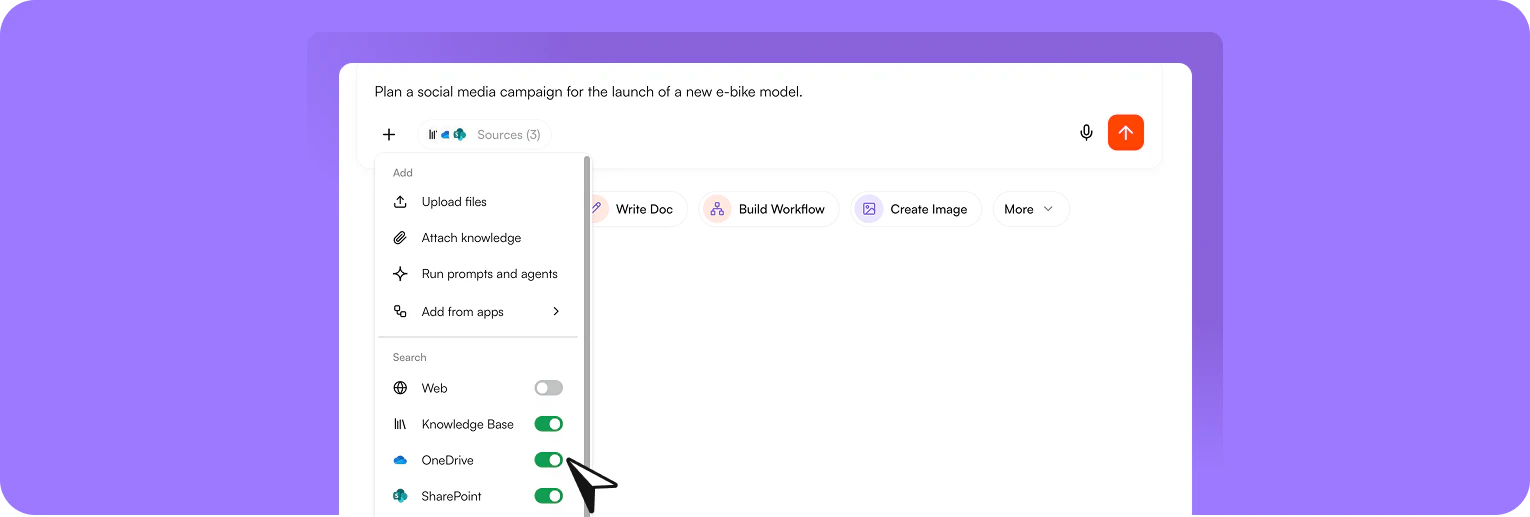
Use web search for up-to-date external information such as trends, market analysis, or competitors.
Example: “Which TikTok hashtags are trending in the beauty industry?”
→ The AI scans current rankings, articles, and trend reports. Internal knowledge (your company data)
Use internal knowledge for content that exists only within your company.
Example: “Which headline do we use in the summer campaign?”
→ The AI accesses your style guide and previous campaign documents. Connected apps (e.g. OneDrive, SharePoint, Outlook)
Use connected apps when information is stored in your daily tools.
Example: “Summarize the key points from the project briefing.”
→ The AI searches relevant documents, emails, or files in your connected systems. Important:
You can activate multiple sources at the same time.
Work in a Folder
A chat can carry its own working folder. Connecting a Knowledge Folder to the chat links the conversation to a specific location in nuwacom, where existing files are available as context and new files are stored. This gives ongoing work a clear home: source material, chat findings, and generated files all live in one place, ready for reuse across the team.How it works
- No folder selected: The chat is not connected to any folder. Existing folder files do not inform the conversation, and no new files are stored there.
- Folder selected: Files in the folder are available as context, and new files are stored there. The selection stays active across all prompts in the session.
- Switching folders: A different folder can be selected at any time. It replaces the previous one and becomes the active context and storage location for subsequent prompts.
- Remove a folder: Hovering over the selected folder displays the X. Selecting the X removes the folder, and the chip returns to “Folder.”
Using the folder as context
With a folder active, the files inside it become available as context for the conversation. nuwacom draws on that material to answer prompts, so questions can reference documents in the folder without re-uploading them. Example: A customer success manager selects the “Customer Acme” folder containing the contract, meeting notes, project documentation, and previous support summaries, then asks nuwacom to summarize the current customer status and highlight open topics. How it works- Open a new chat.
- Select a folder, such as “Customer Acme”.
- Ask a question about the files in the folder, for example: “Summarize the current customer status and list the open topics and next steps.”
- Review the response. nuwacom uses the selected folder’s files as context.
Note: Only folders with edit rights are available for selection.
Using the folder to save files
Everything produced or uploaded in the chat is saved to the selected folder in Knowledge, including:- Documents and slide decks created in the chat.
- Other generated files, such as spreadsheets and PDFs.
- Files uploaded into the chat.
- Stay in the chat connected to the “Customer Acme” folder.
- Ask nuwacom to create a file, for example: “Create a meeting briefing document with the current status, open topics, and next steps.”
- Review the generated file.
- The file is saved automatically in the “Customer Acme” folder alongside the source documents.
- You or a colleague can open, review, and reuse it later.
Run agents
Use agents to work through more complex tasks directly in chat in a structured way. An agent guides you through the process step by step, asks targeted questions, and takes stored knowledge, instructions, or documents into account when needed. Call the right agent via the @ menu. To do this, type @, select agents, and search for the desired agent. You can then start it directly in your current conversation. Example: Start a social media agent that is linked to your brand guide. The agent asks for target audience, platform, and topic, and creates a finished post in the right brand style, including caption and hashtags.Run skills
With skills, you control how nuwacom responds to your request. For example, they define a specific structure, tone, or fixed output format, ensuring consistent results. Call the desired skill via the @ menu by typing @, selecting skills, and searching for the right skill. Then formulate your task directly in chat. Example: Select the “Competitive analysis” skill and write: “Analyze how our competitors are positioned in the market.” nuwacom then creates the response in the defined format of the skill.Run prompts
Use prompts to complete recurring tasks faster and more precisely. A prompt gives your request a clear direction and helps you get better results right away, without having to rewrite the right wording every time. Call the right prompt directly in chat via the @ menu. To do this, type @, select prompts, and search for the desired prompt from the library. You can then use it directly in your current conversation. Example: Select the prompt “Check grammar & spelling”, paste your text, and have it automatically checked for spelling and grammar.Apply voices
Use language styles to create content faster in the right tone. A language style ensures that texts sound consistent, match the brand, and do not require you to explain every time how a text should be phrased. Call the right language style directly in chat via the @ menu. Type @, search for the language style, and mention it in your message. nuwacom then applies the style to your request. Example: Mention the language style “Brand communication” and write: “Write a LinkedIn post about our new feature.” nuwacom then creates the text in the selected language style.Run workflows
Use workflows to run recurring processes faster and more reliably. A workflow bundles multiple steps, agents, or tools into a fixed sequence that you do not have to restart or coordinate manually every time. Call the right workflow directly in chat via the @ menu. Type @, search for the workflow, and mention it in your message. The workflow starts automatically and executes the defined process. Example: Mention the workflow “Calendar briefing” to have your day automatically structured before your first appointment.Source references
Maintain full transparency over the quality of your AI responses – all sources used are traceable and directly accessible. The output shows which sources the AI used. This allows you to choose data sources intentionally and get more precise answers.- Full transparency – all used internal documents and web links are displayed directly below the response.
- Instant fact-checking – click a source to open the original file or webpage and verify information quickly.
- Flexible source control – use the source menu to view and adjust selected data sources for higher relevance and accuracy.
- Higher credibility – traceable sources strengthen presentations, analyses, and whitepapers.
A corresponding citation is shown whenever information from a source is reflected directly or indirectly in the AI-generated response. Sources that contribute to the answer without being directly or indirectly cited may still influence the response and are therefore also listed under “Sources”.
Continue working with AI outputs
Generated outputs can be edited, refined, and collaboratively used within your team in just a few clicks. Below, you’ll find a selection of options – each with a practical example:- Copy and reuse output
Copy generated text and use it directly in other tools – such as emails, presentations, or internal documents.
Example: Copy a generated campaign description and insert it into a sales presentation. - Share output
Easily share content with your team for review or approval. Example: Turn a generated campaign idea into a full blog article and align it with your team. - Real results
Turn AI responses directly into emails, documents, or presentations. The AI automatically structures the content so you can use, edit, or send it immediately.
Example: Turn a meeting summary into an email with key outcomes and next steps. - Generate files
Create ready-to-use files from AI outputs in formats such as presentations (.pptx), Excel sheets (.xlsx), or text files (.txt). The file is generated in the chat and available for download.
Example: Create a presentation for a strategy meeting or an Excel file for competitor analysis.