
- Files are automatically synchronized so the AI always works with up-to-date information.
- Team collaboration is supported, allowing you to share folders with individuals or your entire team and manage access rights precisely.
- a flexible organization is possible, with unlimited folders, subfolders, and direct uploads of complete folder structures.
- Documents are easy to find, thanks to full-text search across titles, file names, and content.
How do I organize files effectively in the Knowledge Base?
The Knowledge Base is the shared foundation for collaboration between your team and the AI. Its content is used as context so the AI can generate answers and content based on your data. Each team organizes its own knowledge area and takes responsibility for its content and structure. Examples:- The marketing team maintains a “Marketing” folder with brand guidelines, campaign materials, product copy, and social media templates.
- The sales team organizes a “Sales” folder with presentations, proposal templates, pitch guides, and pricing sheets.
- The legal or compliance team manages a “Legal & Policies” folder with contracts, data protection policies, approvals, templates, and approved wording.
- Start lean with a clear and intuitive folder structure.
- Structure folders by department, team, or use case.
- Only use relevant and up-to-date content and avoid outdated files.
How is the Knowledge Base structured?
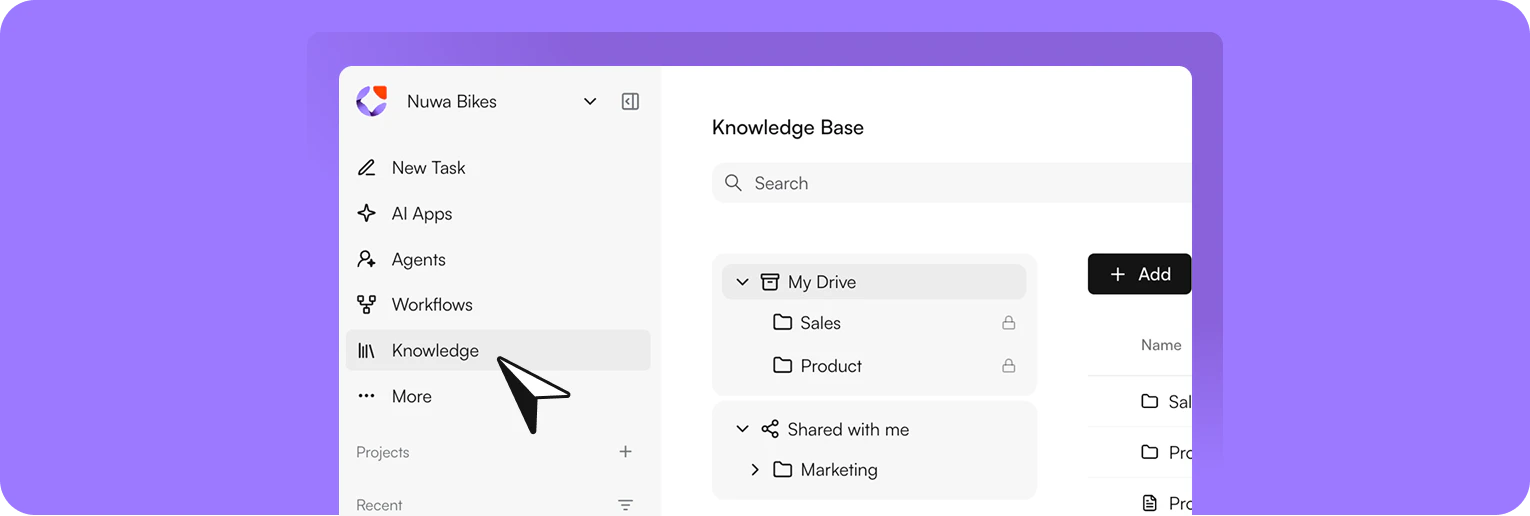
The Knowledge Base consists of two areas so you can quickly find and organize your content.My Drive
Your personal, private area for all files and content you use in nuwacom. Here you can:- Upload files
Upload individual files to use them in chats, projects, or with agents. - Add or upload folders
Create new folders for better structure or upload existing folders including their content. - Create documents
Create new content directly in nuwacom, such as texts, notes, or drafts.
- All content is private by default and only visible to you
- Files from chats or created documents are automatically saved here
- You decide at any time if and with whom you share content
Shared with me
Here you find all files and folders that others have shared with you.- Access all shared content in one place
- See who shared content with you
- Use shared files directly in chat and AI apps
How do I add files to the Knowledge Base?
- Clear ownership: Each team manages its area independently
- Faster onboarding: New team members instantly find structured knowledge
- Scalability: New teams and folders can be added anytime
Create a marketing folder and structure it with subfolders like Brand Guidelines, Campaigns, Product Copy, or Social Media. Upload all relevant documents so the AI can generate on-brand, consistent content and answer questions based on up-to-date information. How it works:
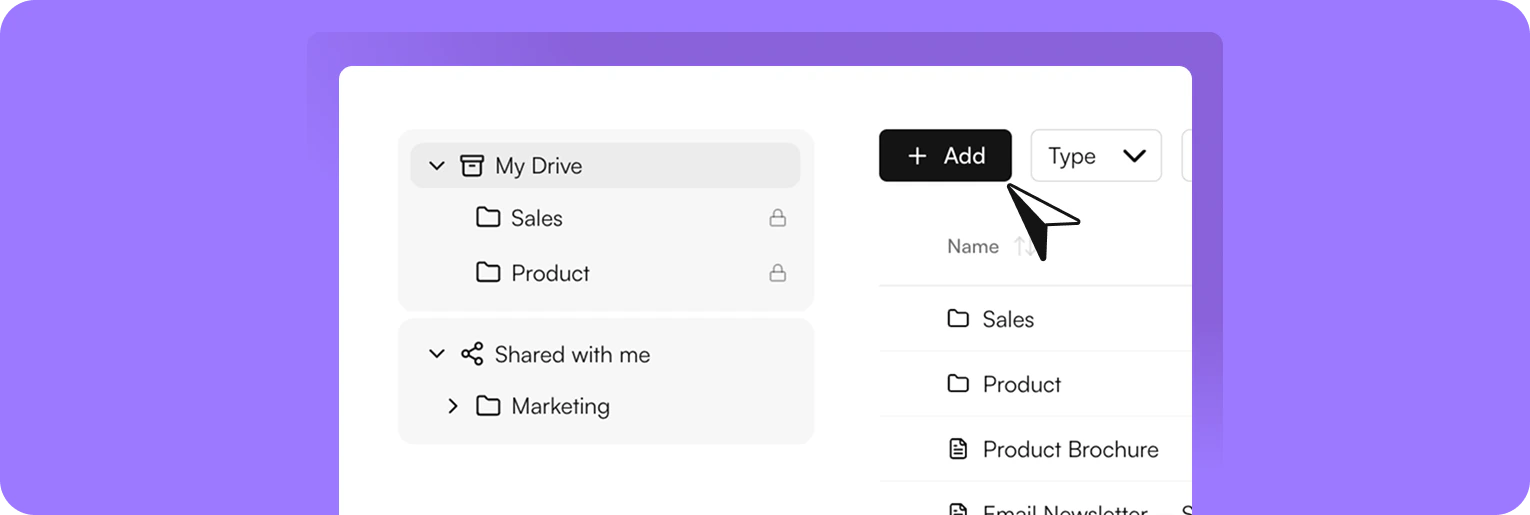
- Navigate to the Knowledge Base.
- Create a new folder and give it a clear name, e.g. “Marketing”.
- Upload the relevant files your team and AI should use as context. You have multiple options:
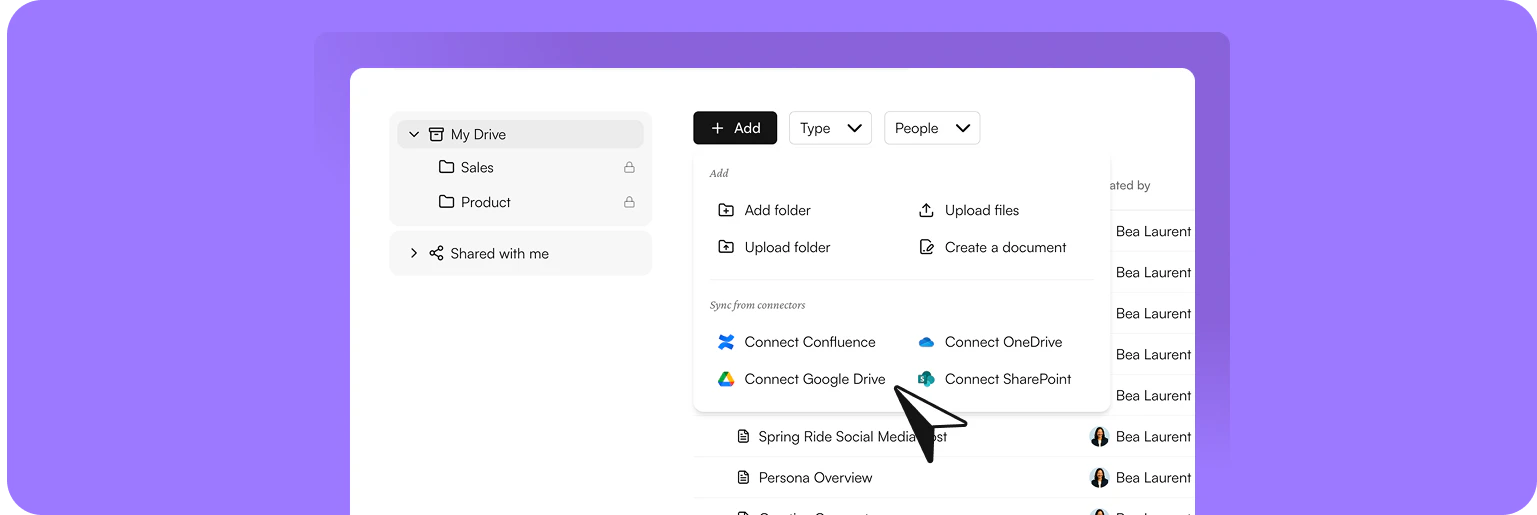
- Sync external connectors: Connect files from OneDrive, Google Drive, or SharePoint.
- Upload files: Upload individual files such as PDFs, presentations, Word documents, or spreadsheets.
- Upload folders: Upload entire folder structures at once. Subfolders and content are included automatically.
- Drag & drop: Drag files or folders directly into the Knowledge Base.
- Create document: Create new content directly in nuwacom, such as notes, briefings, or guidelines.
- Invite your team to use this knowledge together.
- Add the folder to chats, agents, and projects. When you update it, changes are automatically reflected everywhere.
Which file formats are supported?
Supported file formats
Supported file formats
application/jsontext/plaintext/markdowntext/htmlapplication/xmltext/xmltext/x-rstapplication/rtftext/rtf
application/vnd.ms-outlookmessage/rfc822
image/jpegimage/pngimage/webpimage/gif(non-animated)
application/mswordapplication/vnd.openxmlformats-officedocument.wordprocessingml.documentapplication/vnd.oasis.opendocument.textapplication/epub+zip
text/csvapplication/vnd.ms-excelapplication/vnd.openxmlformats-officedocument.spreadsheetml.sheet
application/vnd.ms-powerpointapplication/vnd.openxmlformats-officedocument.presentationml.presentation
application/pdf
- .mp3
- .wav
- .ogg
- .flac
- .aac
- .aiff
- .m4a
- .mp4
- .webm
application/vnd.google-apps.documentapplication/vnd.google-apps.spreadsheetapplication/vnd.google-apps.presentation
- nuwacom documents
- nuwacom meeting notes
How do I share files with my team?
Uploaded files and newly created folders are private by default and only visible to you. You decide when and with whom to share your content.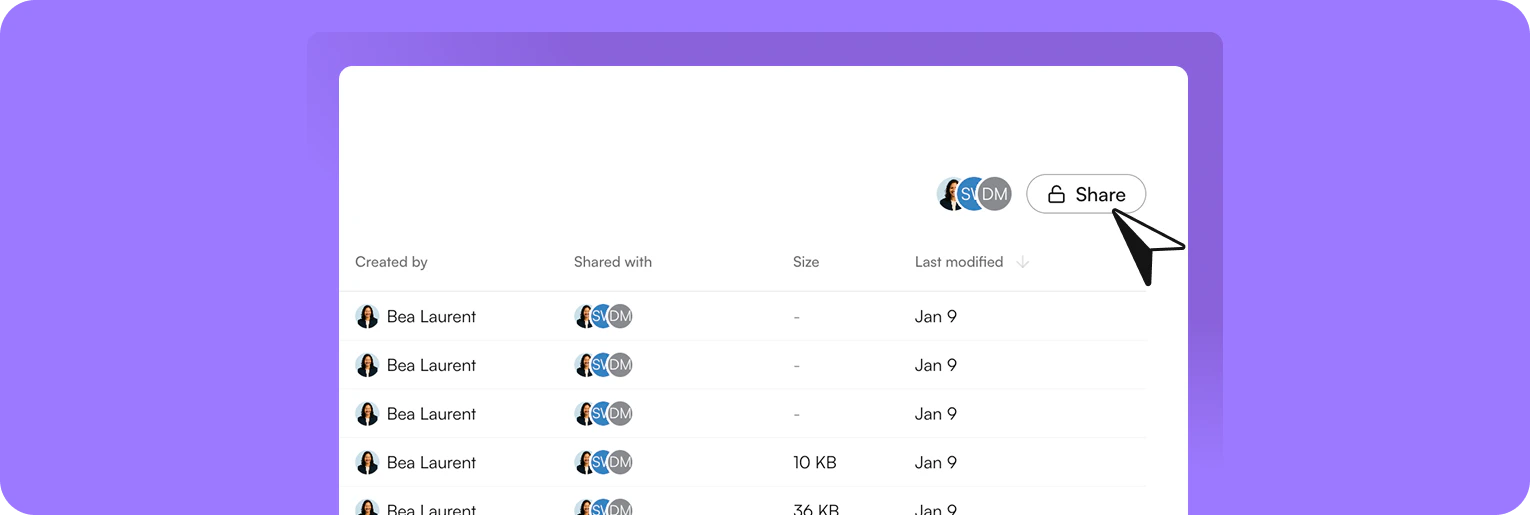
How sharing works
- Open the folder and click Share.
- Select one or more people or share the folder with the entire workspace.
- Set permissions for each person (or the workspace).
Permissions
- View: View files but not edit them.
- Edit: View, add, modify, or delete files.
- Remove access: Revoke access at any time.
A “Policies & Templates” folder starts as private and is then shared selectively—for example, with view access for marketing and edit access for the legal team.
Important: Permission inheritance
- Only root folders can be shared
- Subfolders automatically inherit permissions from the root folder
- When you share a root folder, others get access to all included subfolders and files
- Subfolders cannot be shared individually
If you share the root folder “Policies & Templates” with someone, they automatically get access to all included subfolders and files. The assigned permissions (view or edit) always apply to the entire root folder.
Sync external connectors
- Automatic synchronization: Changes in external data sources are reflected in your knowledge base in real time.
- Preserved structure: Folder structures remain intact.
- No manual updates: The AI always uses the latest content automatically.
- Single source of truth: No version conflicts, no duplicates.
How it works
- Navigate to the knowledge base.
- Select a section and click Add.
- Choose the connector you want, for example SharePoint.
- Connect your account if you haven’t already.
- Select folders or individual files with one click and add them to the folder.
FAQ
Who can set up external connectors?
Who can set up external connectors?
I don’t see external connectors. What can I do?
I don’t see external connectors. What can I do?
Which connectors are supported?
Which connectors are supported?
In which direction does the synchronization work?
In which direction does the synchronization work?
What happens when new files are added in the connector?
What happens when new files are added in the connector?
Can synchronized files be deleted in nuwacom?
Can synchronized files be deleted in nuwacom?
How can I identify automatically synchronized files?
How can I identify automatically synchronized files?
Are the original files stored in nuwacom?
Are the original files stored in nuwacom?
Who can access synchronized files?
Who can access synchronized files?
How can I share synchronized files with others?
How can I share synchronized files with others?
Are permissions from external data sources applied?
Are permissions from external data sources applied?
What happens if a folder is shared with users who don’t have access in the connector?
What happens if a folder is shared with users who don’t have access in the connector?
Web crawler
With the integrated web crawler, you can automatically add content from publicly accessible websites to your knowledge base.- Continuous analysis: The web crawler regularly checks defined websites
- Real-time detection: Changes are automatically detected and synchronized
- Dynamic content: Even changing websites stay up to date
- Company websites
- Product documentation
- Public knowledge bases
- Industry news and updates
FAQ: Frequently asked questions
Who has access to my storage?
Who has access to my storage?
How can I share (sub-)folders?
How can I share (sub-)folders?
How should I structure my knowledge base effectively?
How should I structure my knowledge base effectively?
Can I link entire folders to chats, agents, and projects?
Can I link entire folders to chats, agents, and projects?
Who can upload and manage files?
Who can upload and manage files?
How do I share files with other users?
How do I share files with other users?